Window of Tolerance
Your Nervous System Is Not Broken: Understanding the Window of Tolerance & Polyvagal Theory
If you’ve ever thought, “Why do I overreact?” or “Why do I shut down when things get hard?” — this isn’t a personal flaw. It’s your nervous system doing exactly what it learned to do to keep you safe (its adapted - not broken).
Two frameworks I regularly use in therapy to help make sense of these patterns are the "Window of Tolerance" (Dr. Dan Siegel) and Polyvagal Theory (Dr. Stephen Porges). Together, they offer a powerful way to understand stress, trauma, and emotional regulation — without shame (and fit super well with EMDR!).
The Window of Tolerance (Dan Siegel)
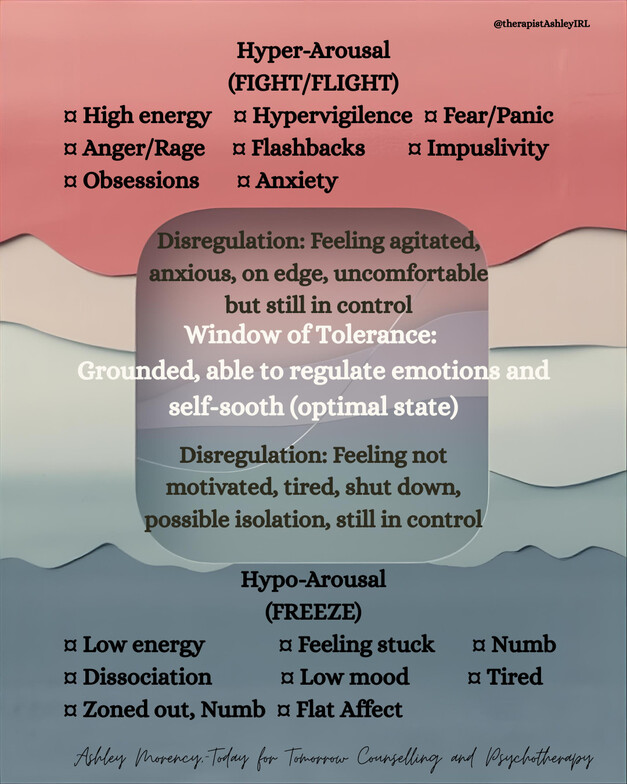
Dr. Dan Siegel describes the Window of Tolerance as the zone where our nervous system is regulated enough to function well. When we’re inside this window, we can think clearly, feel emotions without being overwhelmed, stay connected, and respond intentionally.
Trauma and chronic stress can narrow this window.
When that happens, we often move into one of two survival states:
Hyperarousal
This looks like anxiety, panic, irritability, racing thoughts, and hypervigilance. The body is mobilized and bracing for danger.
Hypoarousal
This can feel like numbness, shutdown, depression, fatigue, or emotional disconnection. The nervous system slows everything down as a protective response.
Neither of these states means something is “wrong” with you. They are adaptive responses shaped by experience.
A central goal of therapy is not to eliminate these states, but to *expand your window of tolerance*, so regulation becomes easier to access and less fragile.
Polyvagal Theory (Stephen Porges)
Dr. Stephen Porges’ Polyvagal Theory helps explain why our nervous system shifts the way it does by focusing on safety and threat.
According to Polyvagal Theory, we move through three primary states:
Ventral Vagal (Social Engagement)
This is the state of safety, connection, and presence. Here, we feel grounded, curious, and emotionally available.
Sympathetic (Fight or Flight)
When danger is detected, the nervous system mobilizes. Heart rate increases, muscles tense, and the body prepares to act.
Dorsal Vagal (Shutdown / Freeze)
When threat feels overwhelming or inescapable, the system may shut down — leading to collapse, dissociation, or withdrawal.
These shifts are automatic. They are not conscious choices. And they are deeply shaped by past experiences.
How This Shows Up in Therapy
Understanding the nervous system changes how therapy works.
Instead of asking “How do we stop this symptom?” we ask “What does this nervous system need right now?”
This may include:
-
Trauma-informed care that recognizes symptoms as survival strategies (EMDR)
-
Somatic and regulation-based tools like grounding, breathwork, orienting, and mindfulness (a large part of work in all the phases of EMDR)
-
Neurotherapy approaches such as neurofeedback and neurostimulation
Why This Matters
For clients, these frameworks reduce shame and increase self-compassion.
For therapists, they provide a roadmap for working with the nervous system rather than against it.
Healing isn’t about never getting dysregulated.
It’s about building the capacity to notice, recover, and reconnect.
Your nervous system isn’t broken.
It adapted — and it can learn safety again.
I hope that this helps you to feel less "shame" around the reactions, and helps you understand yourself better.
Take care,
Ashley

Ashley Morency
Contact Me